Guide · Printable
Free Piping Practice Sheets (Printable PDFs)
Print 12 free cake piping practice sheets for A4 or Letter, pipe on the grey shapes, then photograph the page to get a score out of 100 and your top fixes.
Practise it
Download the sheets
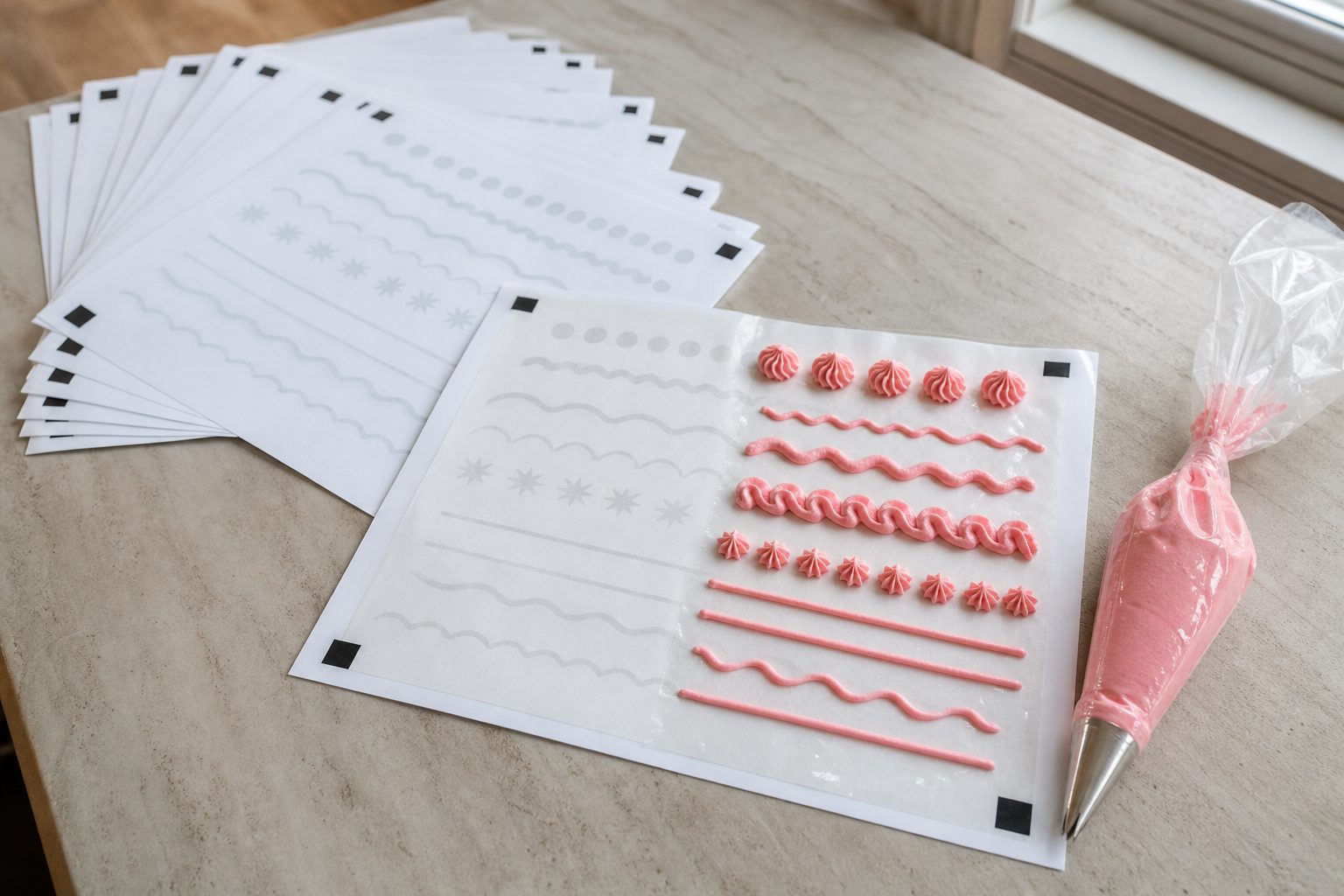
True-size PDFs with the four corner squares. Print at 100% (actual size), pipe on the grey shapes, then photograph the sheet and score it.
A piping practice sheet gives you something to follow. Instead of piping freehand onto a plate and guessing whether it looks right, you pipe over a pale grey shape and can see exactly where you drifted. These twelve sheets are free to print, they fit A4 and US Letter paper, and each one trains one technique with one piping tip.
Pick a sheet below, print it at 100%, pipe it with buttercream, then take one photo. The app flattens the photo, compares your icing with the printed shapes and gives you a score out of 100, a heat map of the trouble spots and a replay of the right move.
Twelve printable sheets, one technique and one tip each, with A4 and Letter PDFs.
Which sheet should you print first?
Start with Lines and dots. It uses the plain round tip 3, it takes about 8 minutes and it teaches the two things every other sheet depends on: steady pressure and a clean finish. Then move to Stars (open star tip 21) and Shell border (tip 21 again), so you only need two different tips for your first three sheets.
Those three are the free starter set. Each sheet is labelled beginner, improver or confident, so you can go in order or jump to the technique you need for a cake you are planning. The table shows all twelve at a glance.
| Sheet | Tip | Level | About |
|---|---|---|---|
| Lines and dots | 3 | Beginner | 8 min |
| Zigzags and waves | 3 | Beginner | 10 min |
| Loops | 3 | Improver | 12 min |
| Block letters | 3 | Improver | 12 min |
| Shell border | 21 | Beginner | 10 min |
| Reverse shells | 21 | Improver | 12 min |
| Stars | 21 | Beginner | 8 min |
| Rosettes | 1M | Improver | 12 min |
| Drop flowers | 2D | Beginner | 10 min |
| C and S scrolls | 21 | Improver | 14 min |
| Leaves | 352 | Improver | 10 min |
| Ruffle border | 104 | Confident | 14 min |
Lines, dots and zigzags (round tip 3)
The round tip is the best place to build control, because a round bead shows every wobble. Lines and dots is the first sheet most people should pipe. Zigzags and waves adds turns: sharp corners where you keep squeezing, and smooth waves where you move your whole arm.
Lines and dots practice sheet
Straight lines and round dots with a plain round tip. The first sheet everyone pipes: it teaches steady pressure and a clean finish.
Zigzags and waves practice sheet
Sharp zigzags and flowing waves. Practise turning smoothly while the bead stays the same width.
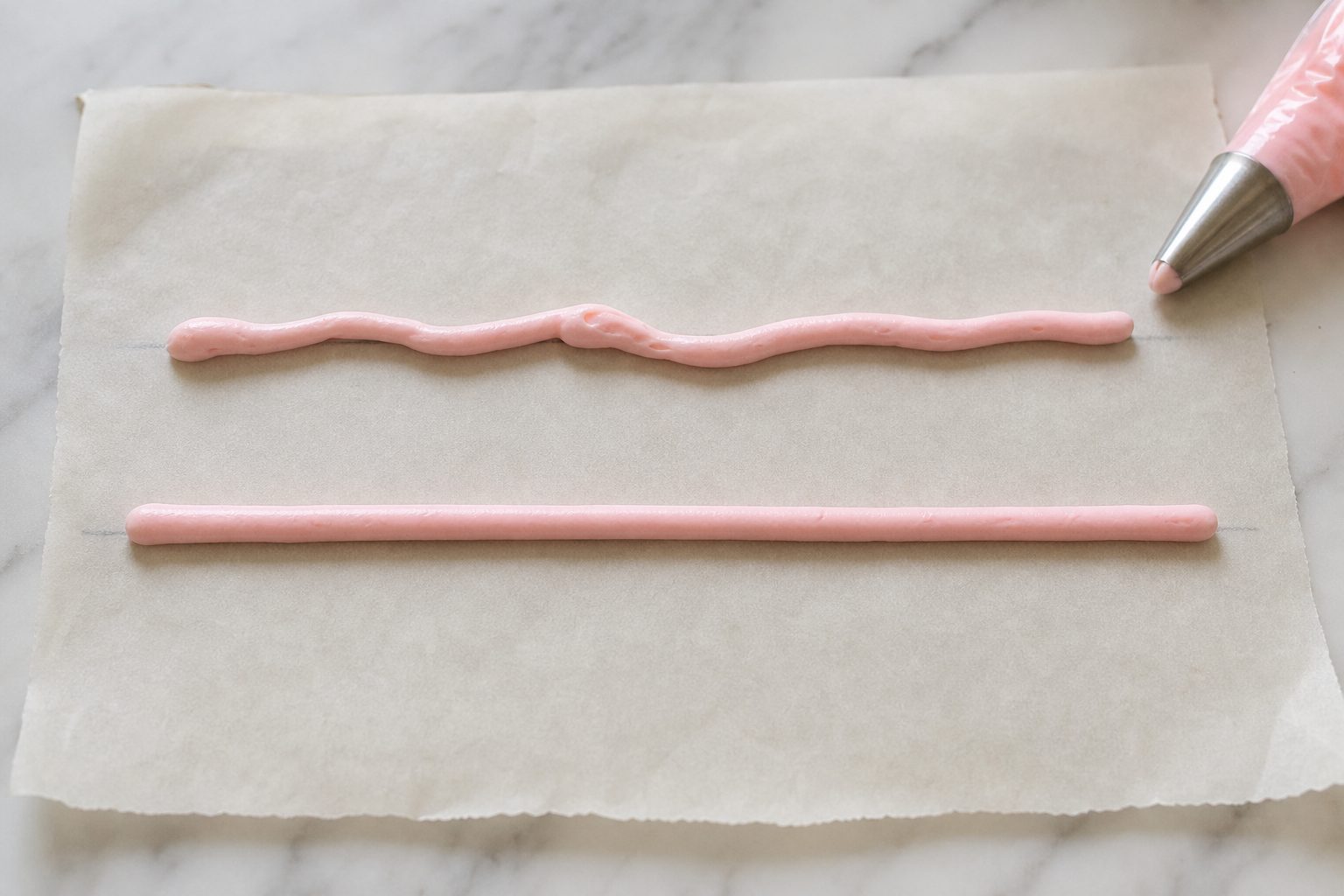
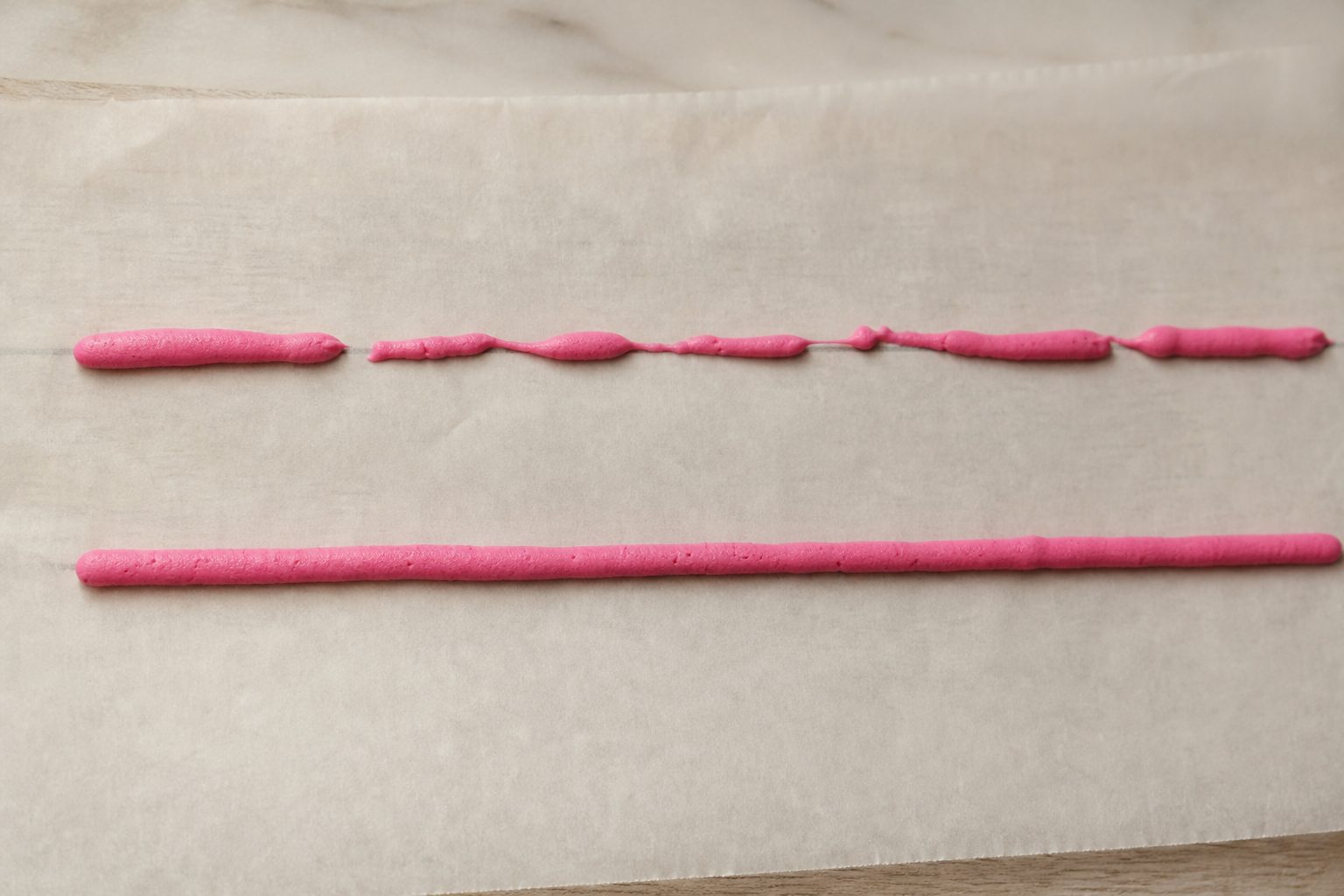
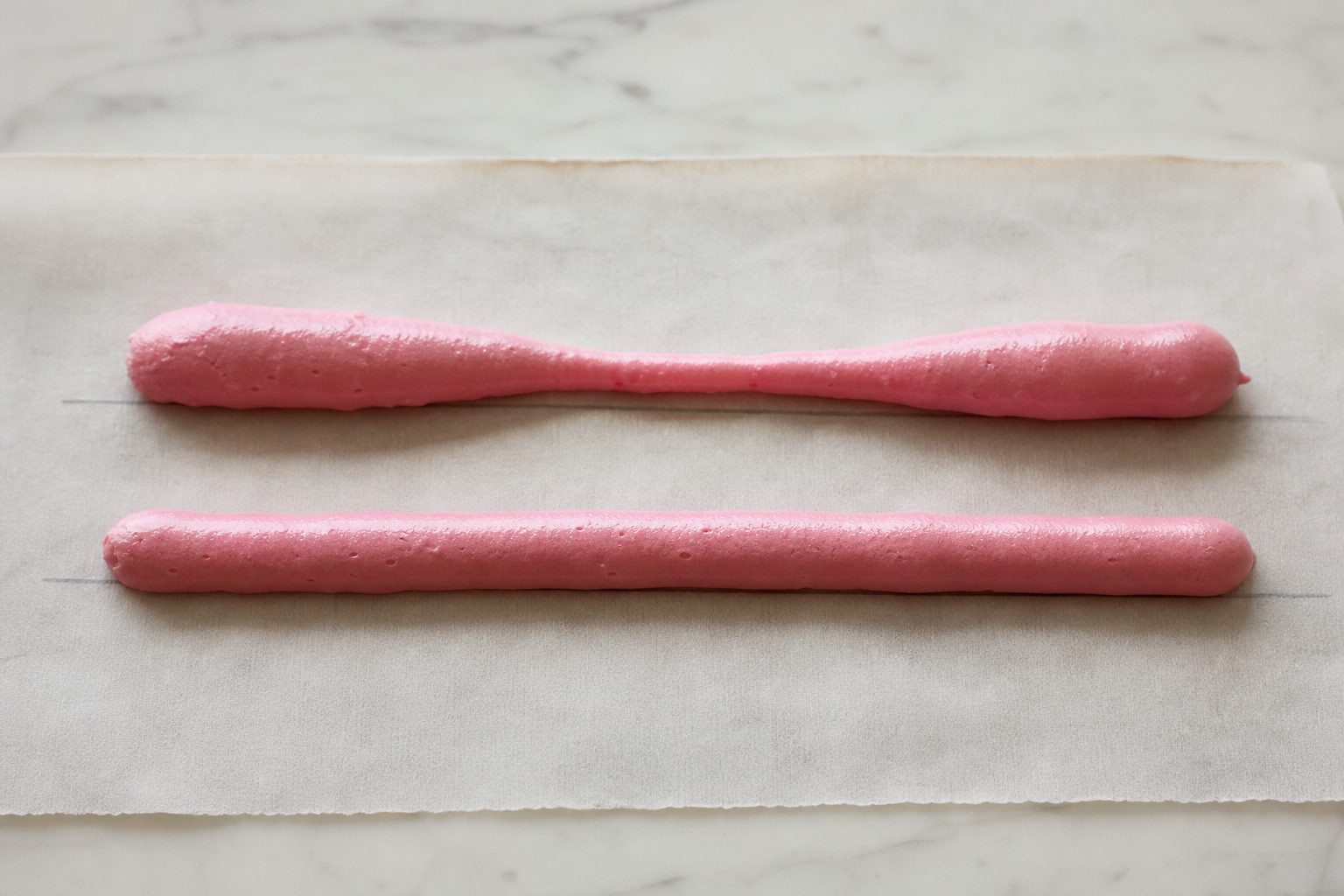
If your lines come out shaky, read the wobbly line fix. If they break up or change thickness, check gaps and breaks and thin then thick.
Loops and block letters (round tip 3)
Once straight lines feel calm, practise rhythm. The loops sheet has small e-loops and tall cursive l-loops, the movement behind decorative borders and cursive writing. Block letters spells CAKE and LOVE in plain capitals and trains you to stop, lift and start again cleanly.
Loops practice sheet
Rows of small e-loops and tall cursive l-loops. The rhythm behind cursive lettering and decorative borders.
Block letters practice sheet
Spell CAKE and LOVE in plain capital letters. Practise stopping, lifting and starting again cleanly.
Shells, stars and scrolls (open star tip 21)
The open star tip 21 makes the classic cake-edge look. Shell border is the one to learn first: squeeze, ease, pull. Reverse shells lean one way and then the other so they hug together into a rope. Stars teach pressure and a straight-up lift. C and S scrolls tie shells and borders together.
Shell border practice sheet
The classic cake-edge shell border. Squeeze, ease, pull: that is the whole move.
Reverse shells practice sheet
Shells that lean one way, then the other, so they hug into a rope. Great for tall or vertical borders.
Stars practice sheet
Plain stars in rows, a pyramid and a ring. The easiest way to learn pressure and how to lift straight up.
C and S scrolls practice sheet
Curved C and S scrolls from a star tip. They tie shells and borders together.
Rosettes and drop flowers (big star tips)
Rosettes use the large open star tip 1M. You start in the middle, spiral out and close the outer ring, and the sheet holds eight of them so you can compare the first with the last. Drop flowers use the closed star tip 2D: one squeeze with a quarter twist makes a flower.
Rosettes practice sheet
Swirled rosettes with a big open star tip. Spiral out from the middle, then close the circle.
Drop flowers practice sheet
Quick piped flowers with a closed star tip. One squeeze and a quarter twist makes a flower.
Leaves and ruffles (leaf and petal tips)
These two are for when the star tips feel easy. Leaves use the leaf tip 352 in a row, in pairs, in a wreath and in a fan, and they frame any flower. The ruffle border uses the petal tip 104 and is the only sheet marked confident: keep the wide end of the tip against the surface and wiggle as you squeeze.
Leaves practice sheet
Leaves with a leaf tip in a row, in pairs, in a wreath and in a fan. They frame any flower.
Ruffle border practice sheet
A frilly ruffle with a petal tip, in a line, a roll and swags. Keep the wide end of the tip against the cake.
How to use a practice sheet
-
Print at 100%
Choose the A4 or Letter PDF and print at actual size. Do not 'fit to page'. Every sheet has a 100 mm bar along the bottom, so you can hold a ruler against it and check the size.
-
Check the tip
The header at the top of every sheet names the drill and the piping tip it was made for. Fit that tip, and keep a damp cloth nearby for stray drips.
-
Pipe on the grey shapes
The templates are pale grey. Keep the tip on the shape, and wipe off any stray drips before you take the photo.
-
Use icing you can see
White icing on white paper cannot be measured. Tint it with a drop of food colouring if it is hard to see against the page.
-
Photograph the whole page
Shoot from straight above in even light with all four black corner squares in the picture. Then upload it to get your score.
How the score works
The photo is flattened onto the sheet using the four corner squares. Then your icing is compared with the printed shapes. The score is out of 100 and is made of four parts.
| Part | Out of | What it checks |
|---|---|---|
| Stray | 40 | Icing outside the grey shape, and how far the middle of your line sits from the guide line. |
| Coverage | 25 | How much of the shape you actually filled. |
| Evenness | 25 | Whether your line width or shape size stays the same from start to finish. |
| Spacing | 10 | For repeated units like shells, stars and flowers: are they the right distance apart and the same size? |
Sheets with no repeated units, such as Zigzags and waves, Loops and Block letters, skip the spacing part and the other three are scaled up so the total is still out of 100. You also get a heat map, red where icing strayed or was missing, plus your top three problem spots with a short replay of the correct stroke.
Each problem spot is given a name, like a wobbly line or icing off the template, with one sentence on how to fix it. Fix one thing at a time and score again.
Taking a photo that scores properly
Most failed scores are photo problems, not piping problems. The app tells you what went wrong, and these are the usual ones:
- Corner squares missing: get the whole sheet in the frame, shoot from straight above, and use even light.
- Too blurry: hold the phone steady, tap the sheet to focus and move closer so the sheet fills the screen.
- Glare: a shiny reflection hides part of the sheet. Tilt the phone or move away from the lamp or window.
- No icing found: the icing is too close to the colour of the paper. Tint it.
Keep practising
If you want a plan, the 30-day piping challenge uses all twelve sheets in order from easiest to hardest, with repeat days so you can measure your own progress. You start and finish on the same sheet.
Do I need all twelve sheets?
No. Start with Lines and dots, Stars and Shell border. Add the others when you want a particular technique.
What paper size do I need?
A4 or US Letter. The sheet is 190 by 255 mm inside the corner squares, so it fits both. Print at actual size.
Can I pipe on a plate instead?
You can practise anywhere, but you only get a score when you pipe on the printed sheet, because the app needs the four corner squares and the shapes to compare against.
Which tips do I need?
The sheets use the round 3, open star 21, open star 1M, closed star 2D, leaf 352 and petal 104. Each sheet header says which tip it needs, and the tip guide explains what each one makes.
What do the numbers on the score mean?
Higher is closer to the printed template. The four parts (stray, coverage, evenness and spacing) are shown separately, so you can see whether your problem is accuracy, filling the shape or consistency.
Upload one photo of your sheet and see a score out of 100, a heat map and the fix for your worst spot.